Turnkey
The whole platform, run by us. You configure brands and trade; we keep the feed, the engine and the servers running. The fastest way to open, and the one that asks least of your own team.
White label
Most sportsbook platforms were built for operators with hundreds of staff, and they are priced that way — a revenue share for as long as you run them, on top of a monthly fee and an integration project. This one was built for operators putting their own brand on it. Same feed, same engine, same trading desk; a different idea of what it should cost to start.
What it costs
The industry default is a revenue share: the platform takes a cut of your gross gaming revenue for as long as you use it, so the better you trade the more it costs you. That is one way to buy a sportsbook. It is not the only one.
The whole platform, run by us. You configure brands and trade; we keep the feed, the engine and the servers running. The fastest way to open, and the one that asks least of your own team.
The platform becomes yours: the source, running on your own infrastructure, with no revenue share and no monthly platform fee. The option the large vendors do not offer, because their business is the percentage.
Somewhere between the two. You own the operation, we run the parts you would rather not staff — the feed, the infrastructure, the upgrades.
Which of the three suits you depends on how many brands you run and whether you have engineers. It is the first thing worth discussing, and it is a conversation about your plans rather than a price list.
What you get
Every line below is a setting or an existing service, not a project. The work that remains is on your side of the wallet, and it is the same work whoever you buy from.
Colours, logo and domain are configuration in the backoffice, applied at runtime. A restyle is a setting rather than a release, and it does not wait for our deployment schedule.
Each brand carries its own countries, limits, currencies and players. An account tied to one cannot read another’s book — the boundary is enforced on every request in the API, not by hiding menu entries.
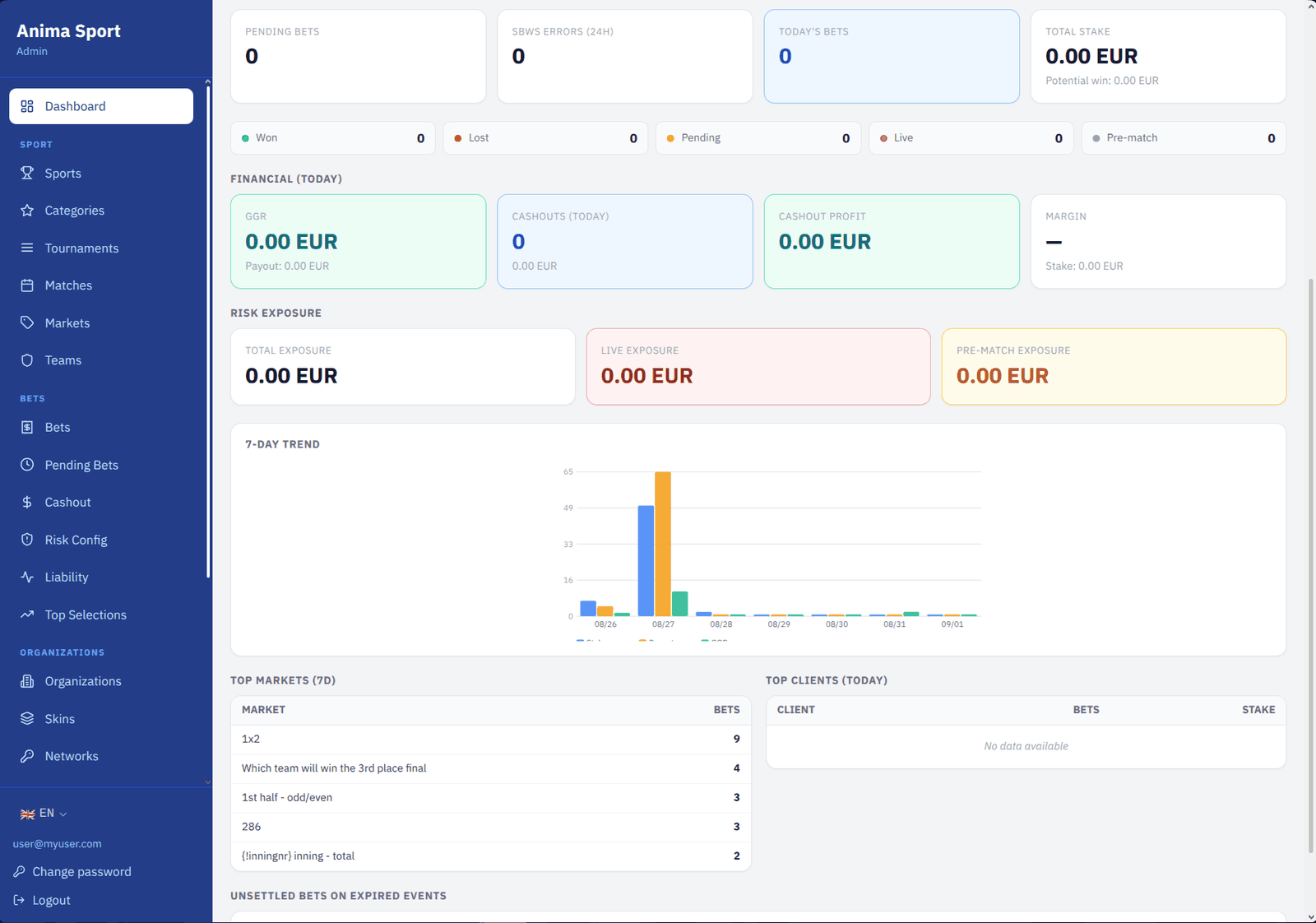
Not a reporting screen bolted on afterwards. The acceptance queue, the liability monitor and the risk thresholds are the same system that prices the bets, so what a trader sees is the state a bet is actually in.
The platform never holds player money. It calls four operations on your platform — authenticate, balance, debit, credit — so your existing account system, and the licence conditions attached to it, stay where they are.
Live and pre-match odds arrive from the upstream provider and are kept current: fixtures, markets, outcomes, and every price change as the game moves. Settlement is handled as the results land.
The player frontend mounts into a div on a page you already control — not an iframe. Your site keeps its own navigation, its own analytics and its own SEO.
The part most demos skip
A platform is judged on a Saturday afternoon, not on a slide. Twenty-five screens are documented one by one on this site — including the ones that only matter when something has gone wrong.
Questions
Answered here rather than in a call, because a page you can forward to your CTO is worth more than an hour of ours.
Not necessarily, and that is the point. Turnkey and managed service are commercial arrangements we agree with you; a source code licence is neither — the platform runs on your infrastructure and there is no percentage and no monthly platform fee. Most large vendors cannot offer that option because the percentage is their business model.
Because less of it is a project. Opening a brand is configuration rather than an integration engagement, several brands run from one installation instead of one deployment each, and your existing wallet stays where it is rather than being replaced. The work that remains — four wallet operations — is the same work whoever you buy from.
No. It is the same feed, the same betting engine and the same trading desk described elsewhere on this site: live and pre-match odds, three-tier acceptance, a liability monitor, twenty-five back-office screens. What is different is who it was built for and how it is sold, not what it does.
Creating the brand, its countries, its limits and its styling is configuration in the backoffice and takes an afternoon. The work that sets the real timeline is on your side: implementing the four wallet operations, and whatever your licence requires. There is no build step on our side between the two.
No. The platform calls your wallet to authenticate a session, read a balance, take a stake and pay a settlement. Money stays in the system you are already licensed to run, which is usually what a regulator expects and always what an operator with an existing player base wants.
Yes, and it is the ordinary case rather than an upgrade. Each brand has its own countries, currencies, limits, styling and players. Staff accounts can be tied to a single brand, so a partner sees their own book and nothing else.
It is held for a trader rather than refused. Three thresholds per rule decide: below the first the coupon is accepted, above the second it goes to the acceptance queue, above the third it is rejected. The thresholds are set per brand and can narrow to one sport or competition.
Whatever the upstream feed carries — football, tennis, basketball, ice hockey and the rest, with the full market set per fixture: 1x2, handicaps, totals, correct score, periods and specials. Esports and virtuals are carried too. Which of them you offer is yours to choose, competition by competition.
The player accounts stay in your platform, because that is where the wallet lives — so there is no account migration in the usual sense. What moves is the betting: your site loads a different script, and the coupons from then on are placed here.
We will configure a brand with your colours, put the widget on a page and walk the trading desk through a live book — and answer the awkward questions rather than the easy ones.
Request a demo