
Sportsbook platform

From the feed to the betslip, and every decision in between.

Anima Sport is a complete sportsbook: a live and pre-match feed, a betting engine that prices and accepts, a player frontend you embed with one script tag, and a backoffice built for the people who have to answer for the book at the end of the day.

21
backoffice screens
each one documented on this site
6
access roles
three of them confined to one brand
5
interface languages
1
script tag to embed
CSS travels inside it

What it is

Four services, one path from the feed to the betslip.

Each one does a job the others do not, and each can be evaluated on its own.

Where prices come from

Feed

A service that consumes the upstream odds feed and keeps the catalogue and the prices current — sports, competitions, fixtures, markets, outcomes, and every change to them as the game moves.

  • Live and pre-match, running as one service or as separate ones
  • Settlement handled as the results arrive
  • Configurable per deployment rather than per build
  • Prices held in memory for the engine to read without a database round trip
What decides whether a bet stands

Betting engine

The service the player’s browser talks to. It serves the catalogue, prices each selection at the moment of placement, applies your risk rules, moves money through the operator’s wallet and pushes every odds change back down the socket.

  • Live prices preferred for events in play, so a frozen pre-match price is never taken
  • Risk limits applied before a bet is accepted, not after
  • Coupons over the limit held for a trader instead of refused
  • Every selection recorded against the brand it was placed on
  • Wallet calls retried automatically, with a manual resend when they cannot be

What the player sees

Player frontend

A self-contained widget — one JavaScript file, CSS included — that mounts into a div on the operator’s page. It carries the whole betting experience: the event list, the match view, the betslip and the player’s open bets.

  • One script tag, no build step on the operator’s side
  • Styled per brand from the backoffice, not per release
  • Odds move in the list, the match view and the betslip together
  • Acceptance and refusal reported back to the player, not left silent

Where the business is run

Backoffice

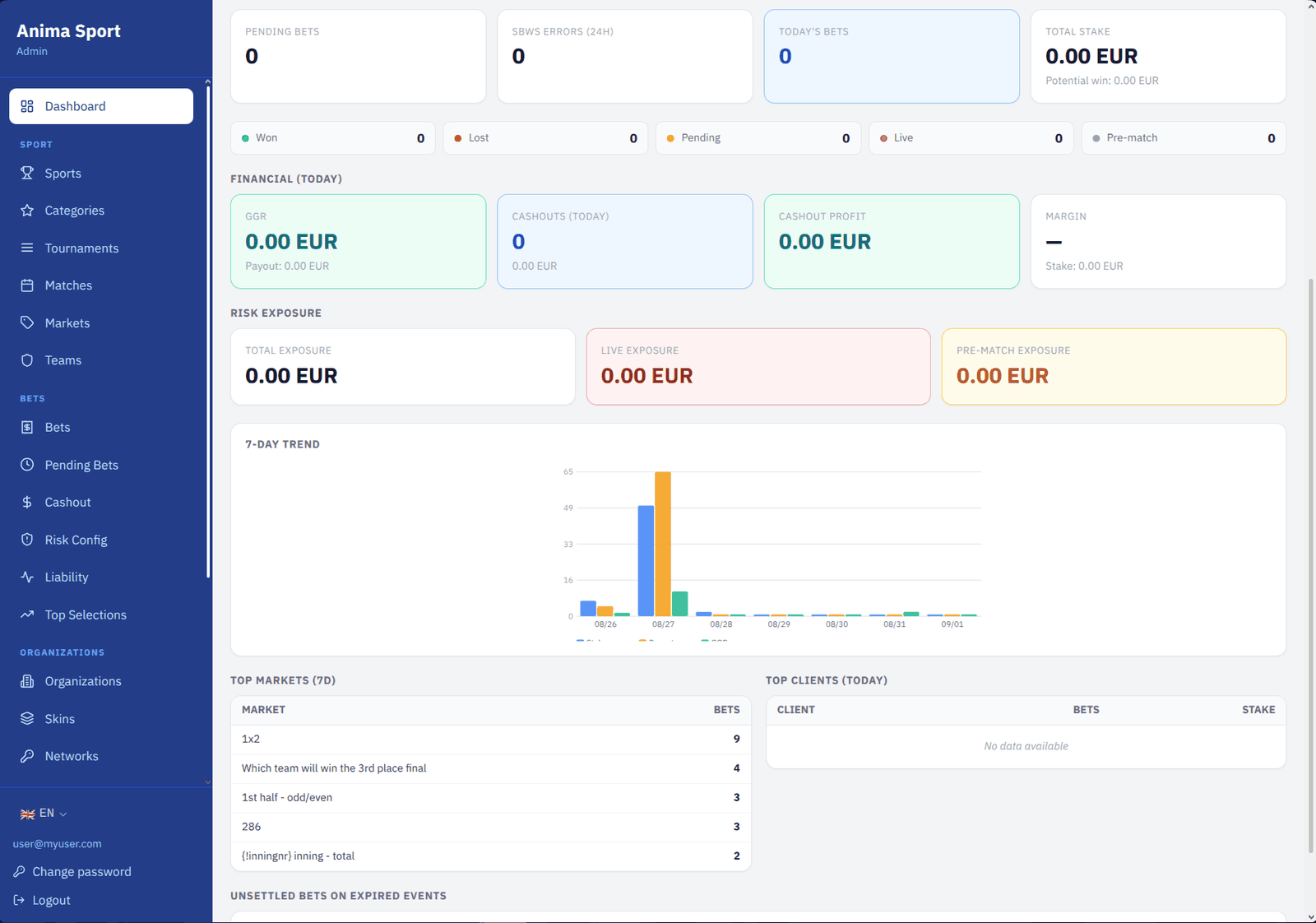
The control room. Trading, risk, compliance, brand configuration and access, in five languages, with every account confined to exactly what it should see.

  • Live activity, turnover and open liability on one screen
  • A liability watch that proposes and never acts on its own
  • Per-brand geoblocking, styling, domains and limits
  • Roles scoped to one organisation, enforced server-side
  • An audit trail with no way to edit it

How it fits together

One host for the player, and nothing in their way.

The player’s browser only ever talks to one host. Prices arrive over a socket from the engine; bets go back the same way. The feed writes into the shared store the engine reads, and the backoffice reads and writes the same store from the other side. Nothing in the player path waits on the backoffice.

Upstream odds feedprices, resultsFeed servicecatalogue + settlementBackofficetrading · risk · brandsShared storePostgreSQL · RedisBetting engineprices · limits · placementPlayer frontendone script on your pageOperator walletyour platformfeedwritesreads · recordsreads · writesREST · socketdebit · creditthe player’s browser

See it with your own numbers.

We will walk you through the backoffice, the widget on a page, and the wallet contract — and answer the awkward questions rather than the easy ones.

Request a demo